Pages

Tuesday, November 11, 2014

Terror at the Shore

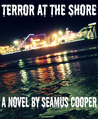
Terror at the ShoreTerror at the Shore by Seamus Cooper
My rating: 3 of 5 stars

The author of Mall of Cthulhu tells a story about a family that takes a seaside vacation at Dagon Heights, NJ.

Families should not take vacations at places called Dagon Heights.

Tongue-in-cheek horror tale (a riff on Lovecraft's The Shadow Over Innsmouth, if you missed the reference), there aren't enough outright jokes to call this a comedy--it's more a very light thriller and reading it is a perfectly good way to spend an evening.

It could also double as the novel version of a teen horror flick (just as Mall of Cthulhu could have been the pilot for a Buffy-knockoff TV series.)  There is the requisite morality play built in, but happily Cooper is enough of a mensch that in his world smoking dope and having sex are not the sins that get punished.

Friday, November 7, 2014

Battle Cry of Freedom

Excellent and very readable account of the Civil War. It starts at the end of the Mexican-American War, and covers the rising tensions tensions in the 1850s--including 'Bloody Kansas', the Dred Scott decision, and the splintering of American politics into a primarily sectional dispute. The war itself is primarily an account of the campaigns, interspersed with chapters on the economy, political disputes, emancipation and other domestic concerns.
Presumably because it's part of the Oxford History series, it ends rather abruptly with the end of the war in 1865, leaving the narrative thread that was leading towards complete emancipation (not to mention the black vote) incomplete, though sparing the reader the depressing story of the abandonment and reversal of those arcs during reconstruction.
Various points:
  • I hadn't realized how much the later war in the Virginia theatre started looking like WWI. Weapons had improved and soldiers had dug in, so assaults became brutal.
  • This might have happened even earlier, but Union leaders in the east before Grant tended to retreat after a failure and Lee would pursue them. Grant simply held the line and attacked again.
  • Along these lines, McPherson argues that suggesting Grant's goal was a war of attrition (where the Union was guaranteed to win) is wrong. Grant’s maneuvering and assaults were intended to push Lee out so he could be decisively beaten. Which failed until Sherman’s southern advance made Lee desperate, when it succeeded.
  • Lee, Jackson, Sherman and Grant come off well as military leaders. McClellan as an excellent administrator with no nerve for combat and Hooker and Burnside as incompetents.
  • Lincoln’s thoughts on slavery changed over his lifetime but very rapidly during the war. Even more dramatic were his thoughts on blacks where he went from an explicit (if fairly indifferent) racism towards being in favor of black voters and defending black troops and POW’s. (See also The Fiery Trial, which I should review sometime, for much more on this.)
  • There were many morbid ironies in the war, among them that the South’s perseverance and early success guaranteed the end of slavery. If McClellan had won in 1862 slavery would have lasted in some form for a generation or two at least.
  • The British elite were basically willing to recognize the South but wanted to wait until it was quite certain the North would admit they were stalemated, which they generally expected to happen ‘soon.’ Napoleon III wanted to recognize the South but didn’t want to go it alone.

The song is jauntier than the book, which was often a brutally depressing read.


Sunday, November 2, 2014

Hammered

Hammered (The Iron Druid Chronicles, #3)Hammered by Kevin Hearne
My rating: 3 of 5 stars

I thought this was easily the weakest entry in the series so far. What I thought was an ongoing throwaway joke ("Thor's a real asshole") is taken at face value and becomes the plot. I kept waiting for a punchline that never came.

Some of the individual scenes are good, though there's not enough of the wolfhound Oberon. The beer Atticus shares with Jesus is funny enough in concept to overlook mediocre execution.

Thursday, October 23, 2014

Common Law & Public Accomodations

[I]f an inn-keeper, or other victualler, hangs out a sign and opens his house for travelers, it is an implied engagement to entertain all persons who travel that way; and upon this universal assumpsit an action on the case will lie against him for damages, if he without good reason refuses to admit a traveler. 
–Sir William Blackstone, Commentaries on the Laws of England

via LGM

Monday, October 6, 2014

Devil in the Grove

Devil in the Grove: Thurgood Marshall, the Groveland Boys, and the Dawn of a New AmericaDevil in the Grove: Thurgood Marshall, the Groveland Boys, and the Dawn of a New America by Gilbert King
My rating: 4 of 5 stars

I'm old enough that I became aware of Thurgood Marshall first as a Supreme Court justice--one of the two stalwart liberals on the court in the '80s. At some point (college?) I learned that he was also the lawyer who won Brown vs. Board of Education, which amazed me as it seemed like enough accomplishment for a lifetime, not a precursor to a long career.

This book goes back a step earlier in his career, pre-Brown, when he travelled the country as a senior NAACP lawyer, taking not only desegregation cases but also being one of the few men who would stand up in court for black criminal defendants being railroaded. It opens with him somehow getting an acquittal for black defendants accused after a riot, then getting out of town without being killed--a real danger in this case. Because their remit was not to be a general legal aid society, and because they had limited resources, he and his colleagues took only cases in which they believed the accused were innocent. Sadly there was no shortage of those in the late '40s, and the main narrative in the book centers on an egregious one in Florida.

The above makes it sound like this book is mostly about Marshall, which is what I thought when I started reading it. But it is at least as much about the corrupt sheriff Willie McCall. The book is written as such a gripping narrative that telling much about the case would feel like giving away spoilers for a seventy-year old series of events. But I will say I'm so used to civil rights narratives being framed as a story of triumphant progress that it took me a long time to realize, quite horribly, that the George Martin quote applied here: "If you think this is going to have a happy ending, you aren't paying attention." It has it's lighter moments and successes, and it's a story of an underdog fighting for justice, grippingly told, but it's not a feel-good book.

My only complaint is the flip side of it being such a good read--it's often written as a breathless you-are-there-narrative, not history. You read about what Marshall was thinking when he faced a probable lynching (roughly "It is never a good thing for a black man in a police car when the officers turn onto a dirt road at night") but it to get the source you need to look up the footnote (Marshall himself, in this case) and there's certainly no discussion about whether I should completely believe the story or maybe 90% believe it because maybe Marshall told a different version another time?

But this is a quibble. Even if you discounted everything that wasn't a matter of public record or agreed to by unsympathetic witnesses there's enough of interest and outrage to make this a phenomenal read.
Monday, September 8, 2014