Pages

Saturday, October 8, 2016

Improbable Transition Forms

An interesting way to view life:

There exists between the sun and the Earth a colossal difference in temperature . . . The energy of the sun may, before reaching the temperature of the Earth, assume improbable transition forms.  It thus becomes possible to use the temperature drop between the sun and the Earth for performing work, as is the case with the temperature drop between steam and water.

Boltzmann, quoted in Morton's Eating the Sun.  From the quote I'm not sure if Boltzmann was really thinking of all of life's intricate processes as just complicated and improbable cascades of energy through electrons and molecules, but Morton definitely is.

Wednesday, March 16, 2016

Mystères à Twin Peaks

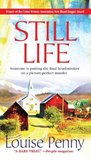
Still Life (Chief Inspector Armand Gamache, #1)Still Life by Louise Penny
My rating: 3 of 5 stars

First in an ongoing and apparently well-loved mystery series; I kind of get the appeal but for me it was not quite what it wanted to be.

The main gimmick (at least for American me) is the small town Quebec setting. There's a murder by hunting arrow (or maybe it was an accident, but of course it wasn't an accident) and big city inspector Gamache and his team turn over stones in the town until they uncover the hidden secret that matters.

Characters, description and plot were satisfying for moderately long stretches--I didn't hate the book. I found the final resolution disappointing but my main complaint was there was too much showing and not enough telling. For example, putatively insightful characters or actions that I thought were shown in such detail as to seem empty puffery. This includes various interview tricks or bits of detection, but the low point for me was a long conversation in which an ex-psychiatrist (part of he local color) explains how she left the profession because realized that some people just don't want to change. This is such a cliche it's a lightbulb joke* but it's presented as if it were a politically incorrect secret that was extracted by a brave soul after a long career. Better at this point I think to skip the details and just remark on her warmth or cutting humor or whatever trait was imagined.

Maybe things tighten up in the later books--the errors seemed avoidable--but there will be other books for me instead of the sequels.

*"Just one, but it has to want to change."

View all my reviews

Red In Horn and Claw

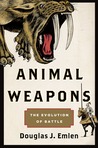
Animal Weapons: The Evolution of BattleAnimal Weapons: The Evolution of Battle by Douglas J. Emlen
My rating: 3 of 5 stars

Why don't all animals evolve fearsome weapons like saber tooth tigers? Why do some beetles have horns at 30% of their body weight? Why do elk grow antlers so big each year that they have to leech calcium from their bones to do so, giving themselves "seasonal osteoporis?"

This is a remarkably clear read about how much more we know that I learned in high school. It's primarily about evolution, and secondarily about the joys of biologist doing field work with dung beetles and howling monkey feces. (I kid; of course there are multiple types of fecal matter during the author's career.)

The outlier in my examples above is the tiger, whose teeth evolved for use in hunting. They came at a cost of mobility, which was acceptable because the tiger became an ambush predator, jumping on larger animals and chomping down. Put the teeth on a lynx or a house cat named Timmy and their hunting skills would plummet. That trade off makes massive weapons rare--thousands of species have them, but it's a relative drop in the bucket of life.

Most animals evolve massive weapons for intraspecies fighting. If you are fighting something with a big horn, it makes sense for yours to be just a little bigger--and the next generation the logic still holds. Once the arms race starts it becomes self-perpetuating, even if the cost is high in resource needs and mobility. Sometimes fights are mostly posturing (which is what I believed was the default starting the book)--fiddler crabs wave their claws and the smaller one backs down. Other times though it's brutal, as elks and deer seem to fight literally round the clock, wearing themselves our, during mating season.

Which raises the question of why fight in the first place? That high school answer was "over females"** and it's correct, but the book covers more specific requirements such as a gender imbalance in breeding-ready animals and geographical restrictions on resources that make defending controlling them worthwhile.

Reading about many of the examples leads to the thought that males really should have something better to do. Think about the way non-breeding ant drones work for the success of their kin; this is the opposite, a species wasting massive resources and energy fighting itself almost entirely for individual benefit. It sounds like some beetles have females digging tunnels, carrying in tastydung, and laying the eggs while the males just fight each other to control the tunnel entrance; this can't be a net positive. But it makes evolutionary in certain situations, at least for a while.

There are asides into human battle, which I admit was part of the gimmick that got me to buy the book but I found almost uniformly lacking in insightful or interesting comments. The author is a biologist, not a historian. Fortunately these sections are quite brief.

*Well, figuratively, but I like the image of male elk staking out mating territory around clocks.

**Or in rare cases, such as the jacana bird, over the males.

View all my reviews

Sunday, November 15, 2015

Terrier

Terrier (Beka Cooper, #1)Terrier by Tamora Pierce
My rating: 3 of 5 stars

Nominally this is a young adult book and I gave it a shot as an audiobook, based on praise for the author various places. I'd probably have enjoyed this more in print. I'm not always sure what "young adult" means with genre fiction of the mind-candy variety. Sure, the protagonist was a 16 year old and there wasn't explicit sex. But there was certainly some gruesome violence in this story of a young guardswoman serving her apprenticeship in the slums, and dealing with poverty, domestic abuse, broken homes, child killers and some miners in bad need of union representation.

Liked it but didn't love it; certainly I get why people recommended Pierce.

Zeus is Dead

Zeus Is Dead: A Monstrously Inconvenient AdventureZeus Is Dead: A Monstrously Inconvenient Adventure by Michael G. Munz
My rating: 3 of 5 stars

About as much fun as you'd hope for from the title, which is to say quite a bit.

The Greek gods withdrew under edict from Zeus; they meddled in the world but only behind the scenes. After Zeus' murder they're back in all their vanity and pettiness, expecting worship. They don't get power from being worshipped, mind you--they just like it.

The muse Thalia (who has picked up science fiction as well as comedy) joins two mortals to try and solve the mystery and provides running commentary. Even sillier and more farcical than someone like Christopher Moore, Munz tosses in a joke whenever he can. Some of the fourth-wall breaking stuff gets tiresome, especially a tendency to write a sentence and then comment on its grammatical weakness in the next one. On the other hand, a few got audible snorts of amusement and the plot was at least 80% satisfying, so pretty happy taking a chance on this one.

View all my reviews

The Emerald Planet

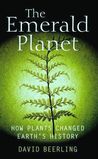
The Emerald Planet: How Plants Changed Earth's HistoryThe Emerald Planet: How Plants Changed Earth's History by David Beerling
My rating: 3 of 5 stars

This is something in between a history of plants on Earth, and a set of essays on that theme. It does start with the development of leaves, and then moves on to the plants' creation of massively high oxygen levels in the Carboniferous (the era of dragonflies with 5' wings) so the first two chapters felt like it would be a tour of plant evolution.

This is probably far too broad a topic, and in any event is not what we get. Nothing about the evolution of flowers or the period worldwide redwood forests, for example. Instead the themes are not merely what was important to plants, but when plants were important to the climate, or even our understanding, through fossils, of the climate. This is a fascinating picture of a dynamic planet, constantly changing in response to a dance between geological processes and plants, which respond and then change the atmosphere and soil in turn.

The chapters cover the science with some technical detail, but also the history of the science, and in some cases the quirks of the scientists. The implications of these sorts of changes to modern day climate change is mentioned more than once, but happily the science is treated as interesting on its own terms, rather than a tool for the present. Some of the research referenced seems cutting edge, which is actually both a complement and a concern--I'd expect at least one or two of the stories to change as we learn more about the distant past. (Not a knock on Beerling, who is quite up front about uncertainties.) My only other nitpick is my ebook was missing the full color plates.

For my own reference the chapters are below--spoilerized, although the stories are tens of millions of years old, it's probably better to just read the book.


Three Men in a Boat

Three Men in a BoatThree Men in a Boat by Jerome K. Jerome
My rating: 4 of 5 stars

This review is written a year after I listened to the audiobook, so details are scant, but this was one of the best audio choices I made.

A more-or-less totally fake memoir of Thames boat trip by three upper class twits in the late 19th century. Life on the Mississippi for the Eton crowd, as it were.

"Jerome K. Jerome" (the character) is a bit like Bertie Wooster, self-absorbed, pampered and clueless. He does, however, have a knack for narrating hilarious scenes of embarrassment and self-inflicted pain. He generally lacks Bertie's good nature or touching loyalty to his friends, which is actually good since he is so often the victim of his own shallowness that I was glad it wasn't happening to a nicer guy. There are some wry observations and wisdom but mostly just a series of very funny sketches.