Showing posts with label bestiary. Show all posts
Tuesday, March 3, 2015
Spider walks down the street in a hat like that . . .
"Sparklemuffin", aka Maratus jactatus. While dancing, no less . . . that's its leg it's sticking up in the air.
from
Tuesday, August 5, 2014
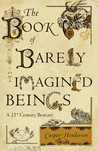
The Book of Barely Imagined Beings: A 21st Century Bestiary by Caspar HendersonMy rating: 4 of 5 stars
This was not the book I expected when I ordered it, but I completely loved it.
I thought I was getting a coffee table book about biology with lots of pictures, instead turns out it's mostly words. (The hardcover is beautifully laid out, though.) The book is twenty-six essays titled around different, often weird, animals. Only some are primarily about their nominal subject. Some are riffs on biological features specific to the animals, others move into more general ruminations about folklore or philosophy or environmental hazards.
To take a couple examples, the opening essay is on the axolotl and spends around half the essay on medieval tales about salamanders dancing in fire and other interpretations of those amphibians--before describing a bit about evolution of the first land animals and how the tiny guys were doing cute little push ups back in the day, before getting around to saying something about the creature itself. Or, for humans, the distinctive feature he picks out is our feet--we're a two legged creature that walks instead of hopping and a lot follows from our bodies need to accommodate that. Chapters on octopuses, Gonodactylus smithii, dolphins and pterosaurs, on the other hand, are more straightforward zoology. (A few bits don't work that well, hence the book narrowly avoiding a 5-star rating.)
Since I have a visceral dislike for the sort of essay that starts with quantum entanglement and ends with the 'interconnectedness of the universe' or something, it took me a while to figure why the barely-science essays didn't bother me. (Beyond the fact that they often quite interesting on their own.) I think it's because Henderson clearly was fascinated by and respected the science; he knew the difference between when he was saying "This is what we've learned from science" and "This bit of science puts me in mind of this story I heard" and doesn't confuse the two.
In closing, here's a picture of a Yeti crab: .
View all my reviews
How could you not love someone with a smile like this?
I'm like six book reviews behind, but it's easier to post a picture of a paddlefish:

And this isn't one of your foreign exotic beauties, either--lives in the heartland of the USA.
But near extinction, dammit.
via PZ Myers.
And this isn't one of your foreign exotic beauties, either--lives in the heartland of the USA.
But near extinction, dammit.
via PZ Myers.
Monday, April 21, 2014
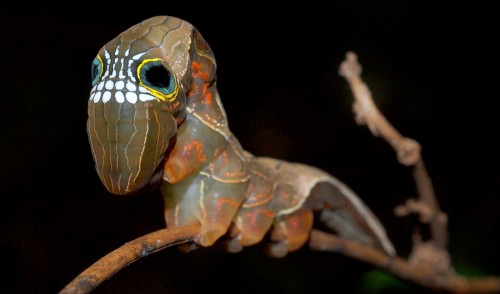
Caterpillar or Luchadores?
I might have become a biologist if we had the internet and so many pictures of colorfully bizarre animals when I was a kid. Probably less lucrative than working in pharma but nature is pretty cool at a macroscopic level too.
Here is a humble caterpillar (Phyllodes imperialis) that evolved a little Mexican-professional-wrestling-mask on its back, so when it's threatened it scrunches up, protecting its head and revealing it's super-powered alter ego.
(The white stuff is apparently supposed to be teeth but they don't work for me.)
via PZ Myers
Tuesday, March 25, 2014
Eat Once, Gain Weight Forever
Not that much to look at, the Convoluta roscoffensis is a flatworm that eats algae until the algae is producing enough nutrients through photosynthesis to keep the worm alive. Adults don't need to eat at all.
It seems somehow appealing, although upon consideration it's like the anti-diet--all the calories of a good meal with none of the taste.
Monday, March 17, 2014
More Beasts
E, F, and G in the Book of Barely Imagined Beings were all disconcertingly alien, covering eels, flatworms and a smasher shrimp. It was actually difficult to read on a sunny weekend afternoon, especially since it followed the very charming dolphin chapter.
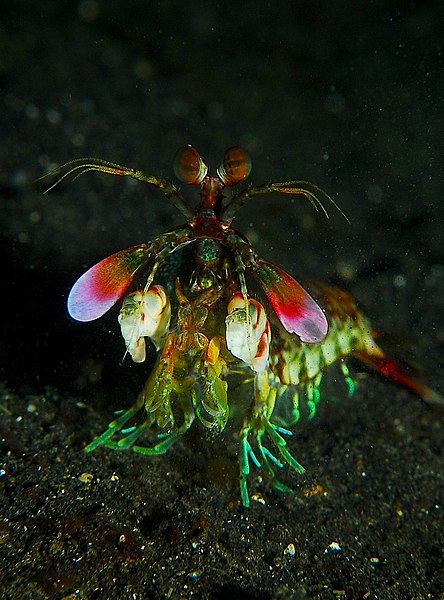
This, for example, is the shrimp Gonodactylus smithii:
It's got an appendage it uses to club things with, which shoots out at near-bullet like speeds, enough to break a human bone. Happily, despite the dirty genus name the 'appendage' is not its penis, but just a specialized limb. Apparently there are 'smasher' and 'spearer' shrimps, and the smashers want to be able to club through shells to get to their meat.
Most of the description in the book focuses not on its threatening bullet-finger, though, but its vision. It can distinguish polarized (in common with other marine species) and circularly polarized light (a unique ability), letting it see transparent animals and invisible-to-us features quite easily.
This, for example, is the shrimp Gonodactylus smithii:
It's got an appendage it uses to club things with, which shoots out at near-bullet like speeds, enough to break a human bone. Happily, despite the dirty genus name the 'appendage' is not its penis, but just a specialized limb. Apparently there are 'smasher' and 'spearer' shrimps, and the smashers want to be able to club through shells to get to their meat.
Most of the description in the book focuses not on its threatening bullet-finger, though, but its vision. It can distinguish polarized (in common with other marine species) and circularly polarized light (a unique ability), letting it see transparent animals and invisible-to-us features quite easily.
Friday, March 14, 2014
I picked up The Book of Barely Imagined Beings by Caspar Henderson. This an A-to-Z list of real animals, nominally modeled after a medieval bestiary so I assumed, quite reasonably I think, that it would be a coffee table book with lots of pictures. It is not. There are lots of words and very few pictures. It is shameful how publishers let people inflict words on their readers.
To make up for this, I am looking up the pictures on line. The axolotl, for example:
A salamander that looks cute, freakish, or disturbingly like a homonculus in the D&D Monster's Manual I had in the '80s, depending on your point of view. Sadly seems to be doomed in the wild (it's range was only Mexican lakes to begin with) but will survive in laboratories studying regeneration and among aquarium owners.
Other things learned: Apparently the first air-breathing vertebrates evolved to thrive in murky, shallow waters where (like our friend about) they could run around on their short stubby legs and do little push-ups to gulp in oxygen that was in short supply in the water itself. I'm not sure what I thought the driving force was, maybe just fish and beaches and something more like this:
Subscribe to:
Posts (Atom)