Pages

Saturday, April 18, 2015

Dresden Takes It, Dishes It Out

Changes (The Dresden Files, #12)Changes and Turncoat by Jim Butcher
My rating: 3 of 5 stars

We've come a long way since the charm of the early books where professional wizard Dresden, with his add in the yellow pages, was a hardboiled dick in the classic mode, a tiny non-entity who kept getting dragged into problems above his weight class.

He's still outmatched, but only because he's facing enemies of unfathomable power instead of corrupt FBI agents or whatever it used to be. Enjoyable, but now the charm comes from seeing how over the top the stuff can get.

Turncoat is mostly White Council plotting, and pretty much action from page one.  I think it's the first time Butcher works in "Dresden is one of the elite wizards"--not just in the wrong place at the right time, but a real player based on raw talent, even without real allies on the council

Changes involves the half-vampire Susan, his fairy godmother, and some time in central America. Some stories that had their origins many books ago get tied up while adding in some new loose ends that will be doubtless picked up later.

Tuesday, March 3, 2015

Spider walks down the street in a hat like that . . .


"Sparklemuffin", aka Maratus jactatus.  While dancing, no less . . . that's its leg it's sticking up in the air.

from

Sunday, March 1, 2015

Science Book Catch Up Day

As long as I'm catching up on science reviews, I'll park this quote here as well:
Unfortunately, many of the papers on asparagus urine are short and lack detail.
from http://udel.edu/~mcdonald/mythasparagusurine.html via metafilter.  Need to go back and read more on the site.  Any site that has that sentence is worth reading.

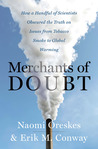
Merchants of Doubt

Merchants of Doubt: How a Handful of Scientists Obscured the Truth on Issues from Tobacco Smoke to Global WarmingMerchants of Doubt: How a Handful of Scientists Obscured the Truth on Issues from Tobacco Smoke to Global Warming by Naomi Oreskes
My rating: 3 of 5 stars

It is alarmingly easy it is to spread doubt about settled science, if you have some cash to spare and are sufficiently motivated.

To be clear, this book is not about the science of second hand smoke, global warming, or CFCs, but how the science is filtered as it gets to the public and policy makers. You will not come away with additional arguments you can use against self-styled skeptics. I mostly just found it depressing (though well written & researched.)

Bill Bryson Has a Good Job

A Short History of Nearly EverythingA Short History of Nearly Everything by Bill Bryson
My rating: 3 of 5 stars

This book reads a bit like a TV documentary series on science. Thirty chapters that start with the big bang, move to the formation of the solar system, the Earth, the appearance of life and so on up to our species in the present day. The actual contents of each chapter are driven by accessibility and interest, though--what makes an entertaining twenty pages as opposed how best to explain some specific topic. So you could get the science, the history of the ideas, anecdotes about quirky scientists, or why it's possible that Wyoming could explode (yes, the whole state.)

Bill Bryson has a knack for entertaining explanations, so the book is wonderfully enjoyable. And I don't mean to imply I didn't learn anything--I learned a ton, even about areas I felt I was reasonably well informed about. I am a bit jealous, as "reading about science, interviewing scientists and writing an essay" sounds like a great job description that would suit me just fine, if you ignore that I'm missing the required research and writing skills. Instead, I settle for cocktail party anecodtes about Huxley asphyxiating himself (for science!) or Lavoisier's income as a tax collector (mind-bogglingly large.)

Endless Forms Most Beautiful

Endless Forms Most Beautiful: The New Science of Evo Devo and the Making of the Animal KingdomEndless Forms Most Beautiful: The New Science of Evo Devo and the Making of the Animal Kingdom by Sean B. Carroll
My rating: 4 of 5 stars

I don't know how many articles I've read in the last 10+ years that have tried to explain some of the discoveries about how a cell "knows" it should become a liver cell or a skin cell and why we don't end up with shoulder blades in our kidneys. These articles got my level of understanding from "I bet it's complicated" to "It's complicated and has something to do with HOX genes."

Reading this book is the first time I feel I "got it"*, at least somewhat, but based on my own reading history I won't pretend I can explain in a couple sentences (or without embarrassing myself in some way or another with various factual errors--it's still complicated.) I will say it's amazing that scientists have figured out so much of how nature's evolutionary toolkit, used to fiddle with morphology over the eons. Those HOX genes are indeed at the center of it, and the discovery that humans and fruit flies share almost exactly identical core sequences is like discovering that the Egyptian hieroglyphics describing how to use an Ikea wrench to build the pyramids.


*Mutants, which I read last year, helped a bit too. A lot of the same science with a different approach.

Saturday, January 31, 2015

Statistical Significance of Healtcare Studies

A post mostly to park this image so I don't have to hunt for it again:


Oregon gave a subset of people access to healthcare by lottery, so you essentially got a randomized population there with and without access.  Massachusetts implemented Romneycare.  Both are obvious things for researchers to study.  Massachusetts study found an effect on outcomes with improved insurance, the Oregon one did not.

So different conclusions from two conflicting studies?  Not at all.  The visualization is a simple illustration show that the studies do not conflict--in fact, they happen to agree embarrassingly well.  However, the Oregon study was at lower power so could not be reported as finding an effect.