Pages

Monday, April 21, 2014

Caterpillar or Luchadores?


I might have become a biologist if we had the internet and so many pictures of colorfully bizarre animals when I was a kid.  Probably less lucrative than working in pharma but nature is pretty cool at a macroscopic level too.

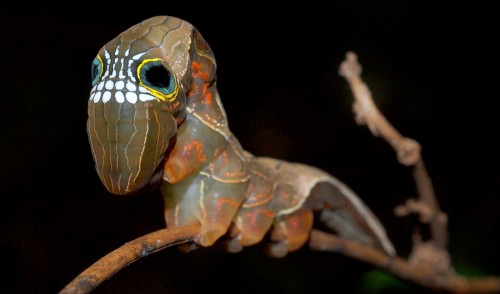
Here is a humble caterpillar (Phyllodes imperialis) that evolved a little Mexican-professional-wrestling-mask on its back, so when it's threatened it scrunches up, protecting its head and revealing it's super-powered alter ego.

(The white stuff is apparently supposed to be teeth but they don't work for me.)

via PZ Myers

The Iron Druid

Kevin Hearne's Hounded and Hexed:

A druid who's something north of 2000 years old has pissed off enough Irish gods that he moves to Tempe, Arizona to get away from them.  Not that they can't get there at all, but there's not enough oak or ash or whatever it is they need to cross over easily.  Unfortunately one of them finds him through the internet and crazy high jinks ensue.

I read this book and immediately got the next one in the series and read that as well.  To be sure, "crazy high jinks" includes a lot of fantasy violence, but otherwise I think the book delivers exactly what my summary would imply.  Even less complexity or shades of grey than a typical Dresden Files book, but it and the sequel are pulpy fast paced entertaining fun.

Oh, and did I mention the conversations he has with his Irish wolfhound?

Tuesday, March 25, 2014

Eat Once, Gain Weight Forever


Not that much to look at, the Convoluta roscoffensis is a flatworm that eats algae until the algae is producing enough nutrients through photosynthesis to keep the worm alive.  Adults don't need to eat at all.

It seems somehow appealing, although upon consideration it's like the anti-diet--all the calories of a good meal with none of the taste.

The American

I'm not sure what I thought of The American as a whole.  I know I didn't like most of it.  Clooney is a hit man exiled to a small Italian town while trouble blows over.  There is very little meaningful dialogue but many medium distance shots of him off center in a mostly empty frame to make it really clear how isolated he is, just in case his brooding and lack of human interaction was missed.  The attitude towards plot can be summed up as roughly "You've all seen this story before.  You'd be as bored as us if we spent screen time working through the details, right?"

But even if most of it felt like someone working from a film school textbook on melancholy, I was a bit surprised in the final scenes that I cared about the characters and they had some real impact.  So not a complete dog of a film.

Monday, March 17, 2014

Dust

Elizabeth Bear's Dust:

A generation ship breaks down and starts orbiting a dying sun, the inhabitants split into factions that start struggling for control of the ship--or just their personal fiefdoms--as the centuries drag on.  This falls into a genre I've never quite gotten, science fiction that explicitly chooses fantasy trappings.  Societies have a medieval structure with inheritance among families and knights going on quests, while genetic engineering and nanotech provide miracles and mythical beings and computer subprograms are like gods.

I continue to like Bear's writing and there are some nice narrative tricks around how things are perceived, plus an interesting take on the differences between love, trust and desire in relationships.  But for me probably not worth continuing with the series.  Certainly I'll exhaust some of her other works (including the excellent Eternal Sky series) first.

More Beasts

E, F, and G in the Book of Barely Imagined Beings were all disconcertingly alien, covering eels, flatworms and a smasher shrimp.  It was actually difficult to read on a sunny weekend afternoon, especially since it followed the very charming dolphin chapter.

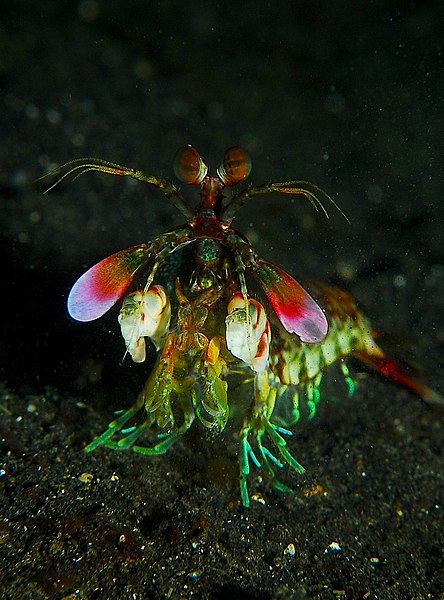
This, for example, is the shrimp Gonodactylus smithii:


It's got an appendage it uses to club things with, which shoots out at near-bullet like speeds, enough to break a human bone.  Happily, despite the dirty genus name the 'appendage' is not its penis, but just a specialized limb.  Apparently there are 'smasher' and 'spearer' shrimps, and the smashers want to be able to club through shells to get to their meat.

Most of the description in the book focuses not on its threatening bullet-finger, though, but its vision.  It can distinguish polarized (in common with other marine species) and circularly polarized light (a unique ability), letting it see transparent animals and invisible-to-us features quite easily.

Friday, March 14, 2014

I picked up The Book of Barely Imagined Beings by Caspar Henderson.  This an A-to-Z list of real animals, nominally modeled after a medieval bestiary so I assumed, quite reasonably I think, that it would be a coffee table book with lots of pictures.   It is not.  There are lots of words and very few pictures.  It is shameful how publishers let people inflict words on their readers.

To make up for this, I am looking up the pictures on line.  The axolotl, for example:

A salamander that looks cute, freakish, or disturbingly like a homonculus in the D&D Monster's Manual I had in the '80s, depending on your point of view.  Sadly seems to be doomed in the wild (it's range was only Mexican lakes to begin with) but will survive in laboratories studying regeneration and among aquarium owners.

Other things learned: Apparently the first air-breathing vertebrates evolved to thrive in murky, shallow waters where (like our friend about) they could run around on their short stubby legs and do little push-ups to gulp in oxygen that was in short supply in the water itself.  I'm not sure what I thought the driving force was, maybe just fish and beaches and something more like this: